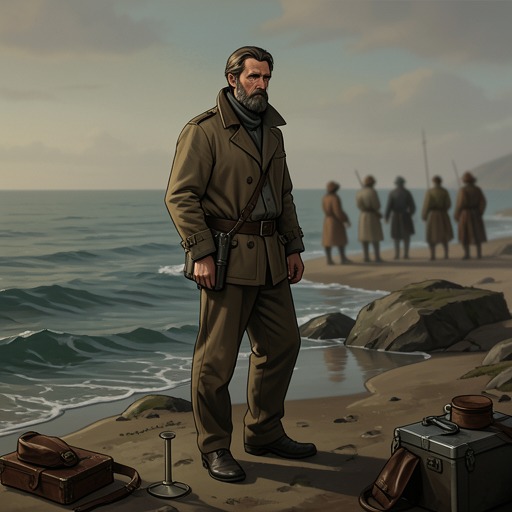
Battle of Britain
Promise at DawnThe Battle of Britain, as recalled by Romain Gary, was a struggle he approached from the airfields and countryside of England rather than from the combat cockpit. Its significance in his account lies not only in the fighting above Britain but also in the contrast between his own exclusion from battle and the courage, losses, and fellowship of those who took part. The campaign unsettled the patriotic certainties formed by his mother, gave practical meaning to his attachment to France, and left him with a lasting sense that the living carried the dead with them.
Certainty Before the Battle
Before the campaign, Gary had not followed events in Europe closely. His upbringing had fostered affection rather than sustained hatred, and he found it difficult to accept killing as a solution to conflict. His mother’s faith in France and its military leaders had served as a kind of protective wall: she had surrounded him with patriotic stories and assurances strong enough that, as he later observed, he did not learn of France’s defeat in 1870 until lycée. When France fell, however, the appeal made by Charles de Gaulle on 18 June 1940 reached him with the force of both a political summons and a familiar maternal voice. He rallied to the call without hesitation.
That response did not mean his assumptions about war had already been tested. In Sweden, seeing a German aircraft cross the sky had been his first direct encounter with the enemy. He had still trusted the French Army and its revered leaders, taking the apparent quiet of France in the face of threats as evidence of strength. His memoir places that confidence beside the later knowledge of defeat: the patriotic world his mother had built for him could inspire loyalty, but it could not prepare him for the realities of military failure or the struggle now being fought in Britain.
Training and Exclusion
Gary’s route toward combat had already been marked by institutional delay. Although his military and law qualifications should have opened the way to officer flight training, he waited nearly six weeks at Salon-de-Provence before being sent to Avord, arriving a month late. He worked to catch up, performed well in flying and infantry leadership, and came to love the open-cockpit aircraft and the freedom left to a pilot’s initiative. The Potez-25, slow enough to be compared in the memoir to a draft horse, and the hand signals used between aircraft belonged to a training system that seemed oriented toward the previous war. Gary presents this outdated equipment and practice as a warning: the French forces were preparing for a new conflict with methods inherited from 1914.
At Avord, despite his performance, he was denied an officer’s commission. He learned that his Russian birth and recent naturalization were being used against him, under a restriction that in principle barred men whose parents were not French or whose naturalization was less than ten years old from becoming flying officers. The rule, he was told, had been criticized as discriminatory but was being applied again. The rejection made his French identity feel newly precarious. Yet Gary describes the injury as producing an unexpected change: the French ceased to seem like a superior or separate people and became, with all their capacity for folly and injustice, human beings like everyone else. His attachment to France became less a matter of idealized national purity and more a choice among the country’s varied faces.
England and the Battle in the Sky
By July 1940 Gary was in England, assigned to training at Andover and posted to the Free French Lorraine Squadron, which was preparing to leave for Africa under Astier de Villatte. The Battle of Britain was being fought overhead, but Gary emphasizes the distance between the pilots engaged in combat and his own position. He watched young English airmen return in bullet-damaged Hurricanes, refuel, reload their guns, and take off again. French pilots, including Bouquillard, Mouchotte, and Blaise, were among those fighting. Gary was not. His bright scarf, worn like the pilots’, was, in his rueful account, his only contribution to the battle.
His recollection makes that absence part of the event’s meaning. He felt friendship and respect for Britain and for the people defending it, even as he remained a trainee looking upward from the ground. This response followed the destruction of the French fleet at Mers-el-Kébir, which had left the French airmen newly arrived in Britain in grief and silence. In Glasgow, Scottish regimental pipers welcomed the French with military music; the French contingent withdrew quietly to its tents, while the pipers continued playing through the park. The scene holds together hospitality and hurt without making either disappear. Gary’s respect for Britain arose within this painful political and emotional divide, not outside it.
Comrades, Loss, and Remembrance
The men who fought became central to Gary’s memory of the campaign. Bouquillard, the eldest of the French airmen aboard the Oakrest, was later the first French ace in the Battle of Britain. He was brought down after his sixteenth victory when his cockpit roof jammed and he could not escape. Gary recalls the pilots in the operations room hearing him sing France’s battle hymn until his aircraft was lost. Writing later beside the Pacific at Big Sur, Gary finds that memory returning with the sound of the ocean. Bouquillard’s absence is not treated as a closed episode: the act of recalling him brings the friend back into the present of the narration. Gary says that no Paris street bears Bouquillard’s name, yet every street in France carries it for him.
The Glasgow group also gives the battle a collective scale. Of the fifty French airmen there, only three survived the war; together, those who fought accounted for 150 enemy aircraft before they too were killed. Gary recounts names and victory totals, then questions what such names can mean to those who have never known the men. For him, they have not truly left: what remains alive in him belongs in part to them. This remembrance turns the campaign from a tally of aircraft into a history of companionship and loss.
Narrative Significance
The memoir tells the Battle of Britain retrospectively, moving between the young trainee’s restricted view and the older narrator’s knowledge of the dead and of what followed. That distance makes the campaign both an event in wartime chronology and a measure of Gary’s changing loyalties. He enters England wounded by the denial of French military recognition, unable to join the pilots whose courage he witnesses, and conscious of the mother to whom he has made promises. The battle does not resolve those tensions. Instead, its comradeship and losses deepen his attachment to France while his welcome in Britain earns his respect.
Gary’s account also resists presenting patriotic belonging as effortless or uncomplicated. His mother’s stories and de Gaulle’s appeal gave France an enduring emotional claim on him, while the exclusion at Avord exposed how institutions could deny the identity he felt was his. In England, the sight of pilots repeatedly returning to the fight made courage visible even to a man kept from combat. The Battle of Britain thus becomes, in his personal history, a threshold between inherited certainty and a harder loyalty: one grounded in chosen allegiance, shared danger, and remembrance of those who did not return.